Thursday, October 31, 2013

Tuesday Wite #7


In the book “The Lord of The Flies”, Piggy’s specs represent true power. The glasses were used to light the signal fire alongside every other fire, and fire is generally a symbol for power over those without fire. When the boys are trying to light a signal fire to signal a ship, the following takes place, “His voice rose to a shriek of terror as Jack snatched the glasses off his face, ‘mind out! Give ‘em back! I can hardly see!’” (40) Throughout the book, Power (or at least the potential for power) is taken from Piggy. Later in that scene, the kids used his specs to light the fire, but also marks the first time that power is forcibly taken from the individual with intelligence by the power-hungry Jack. Later in the book, Jack and his boys stage a raid on Ralph’s camp, taking the specs and injuring Sam, Eric, Piggy and Ralph. After this, Golding describes Jack as “...A chief now in truth… From his left hand
dangled Piggy’s broken glasses.” (168). During the entire book, Jack is always searching for power over his fellow man. This moment represents the point when Ralph and Co. are rendered powerless, they can no longer create fire, and the voice of reason: Piggy is rendered handicapped, and Jack takes over. It can be argued that the conch represents the power on the island. However Jack’s party tends to ignore the power of the conch whenever Ralph tries to use it. The Conch represents order, for as long as it was on the island, there has been some kind of order, but the moment when the conch is shattered and piggy is killed is the moment that the island resorts to savagery.

Piggy’s specs are always being taken from him, disallowing him from having any power in the group, and Jack is always the one taking his glasses from him. Since Jack is represented as a power-hungry individual, and always going after Piggy’s specs, and Piggy has no power without his specs, it can be deduced that Piggy’s specs represent true power on the island.

Wednesday, October 23, 2013


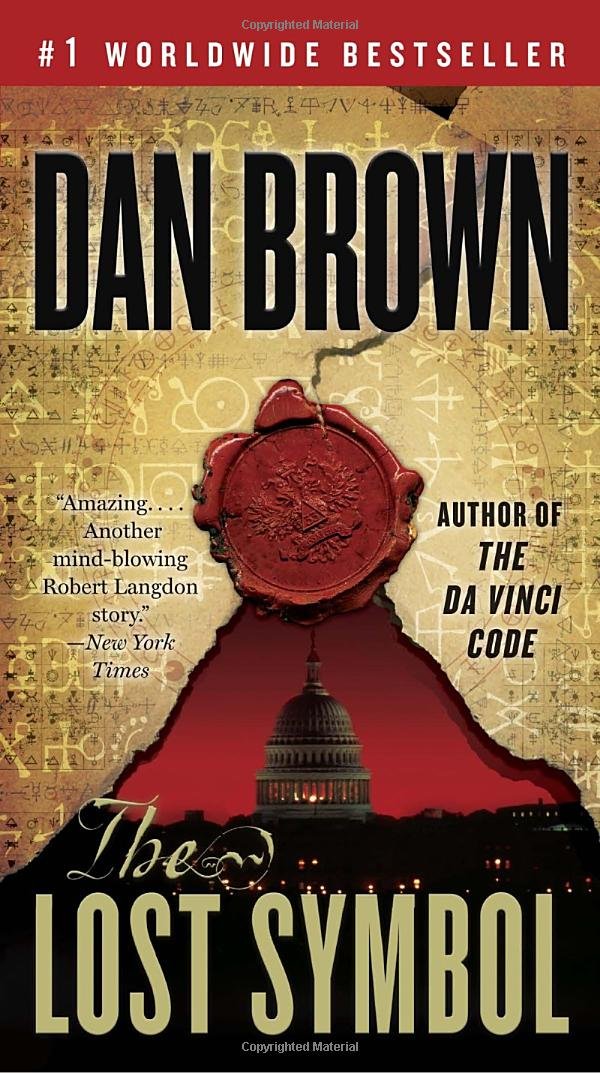
Dan Brown’s “The Lost Symbol:” A peek into D.C.’s darkest secrets

Reviewed by Adam Hillaire

Dan Brown captivates audiences once again with another installment of the adventures of Robert Langdon, The Lost Symbol. The novel takes a closer look into the mysticism surrounding the previously unheard of Masonic Brotherhood, a cult that has knowledge of a multitude of ancient secrets, and has existed for generations. As this is a sequel to the books “The Da-Vinci Code” and “Angels & Demons”, both of which have been criticized for criticizing religion, it has been criticized for being a criticism on religion.

The Lost Symbol is a splendid read for those with an affinity for adventure. It takes place in current-day Washington DC, It starts off with a call from one of Robert Langdon’s rich friends’ assistant who calls him across the country, insisting that he present a speech for an event. Upon Langdon’s arrival, he discovers that the “assistant” who called him over has actually taken his friend hostage and intends to kill him if Langdon refuses to carry out his wishes. Without giving away too many spoilers, I can only say that the plot only thickens from there. The fast-paced chapters keep readers on the edge of their seats. The short chapter design creates many cliffhangers between chapters, which follow 2 plotlines following the adventures Robert, being the main plotline, and the CIA, the subplot, alternately. at one point at the end of a chapter, the narrator describes “If Langdon had not yet grasped his role here tonight, soon he would” (Brown 49). The mysteries and puzzles take up the better part of the book, and slow down the pace a bit, but is still fairly engaging to read. It should also be noted that Brown makes the puzzles in this book very easy to wrap one’s head around, which is nice, because most of the mysteries in this book require a fair bit of research to understand fully. These slower sections also give the reader a chance to get to know what’s going on in the minds of those around langdon. Overall, the pacing is done fantastically, and is probably the best part about the book.

The only bad thing that can be said about The Lost Symbol is that Dan Brown does a terrible job at characterizing his characters and expressing emotions. Everyone in this book is completely two dimensional, Langdon is a Professor from Harvard who knows a lot of stuff regarding symbolism, and the antagonist (Mal’akh) has only 1 goal, and little to no characterization. After the presentation of a very unsatisfying backstory, Mal’akh is given a summarizing description: “His body, once tanned and perfect, was now marred by scars from that night… scars he had kept hidden beneath the tattooed symbols of his new Identity. I am Mal’akh” (Brown 227). He has a little less than a chapter to describe how he got to where he is in this book, and never shows any form of emotion other than ambition. There was a lot of room for improvement on the love interest portion of this book, the relationship between Langdon and Katherine (the noetic scientist heroine) is next to non-existent. There was so much potential for a relationship in this book, it could have easily been squeezed in during the slow portions of the book.

Overall, this book was pretty sub-par. The pacing and plotline was probably it’s only redeeming factor, while the story itself was pretty disappointing. I will, however, say that it is a pretty decent time-killer, Its 510 pages will keep you entertained for about a day if you like the whole sense of adventure theme in a book.


Tuesday, October 15, 2013

Regarding The Warren Harding Error

      1. What stood out to me in this chapter is the fact that a congressman had mistakenly brought someone who would later be known as one of the worst presidents of American history. He just saw this attractive (and charismatic) man on the street and decided to persuade him into becoming a part of politics. It's events like that which make you trust politicians less and less. Of course, Daugherty (the Ohio politician) was going off his unconscious biases about the kind of skills that people like Harding represented (charisma, leadership, wisdom, etc.), which is understandable for any normal person, but this is a politician, a guy who represents the voice of a city. The takeaway message here is that your unconscious biases have the ability to lead you to poor decisions, and that it's better to listen to your higher consciousness, and use reason rather than instinct.

     2. We should take this chapter into consideration for our discussions regarding leadership as they have a certain, crucial correlation about the decision as to who should lead. The way we rely upon our unconscious biases can affect the way we vote for leaders. If we see an attractive, charismatic individual running for a leadership position, regardless of whether or not he's actually a good leader, we'll make the subconscious assumption that he's the better option when compared to an unattractive, non-charismatic individual running for the same position, but is a bit more qualified. We can associate this with LOTF in the sense that, in the beginning of the book, Ralph is noticed more as the quiet type. The boys subconsciously associate him with being the more intelligent, more qualified leader. And to some extent, they were correct, Ralph got the group semi-functioning, he set up a signal fire and got shelters up, but he couldn't demand the obedience of the other children. That was something Jack could do. Jack had the ability to command obedience, but his intentions were a fair bit worse than Ralph's, as Jack wanted to stay on the island and hunt pigs. Getting back to the topic at hand, is there a way to undo these subconscious biases? Yes, but to do so, one would have to spend a fair bit of time around the people that the bias is against. If you have a moderate automatic association of African Americans with bad, then you could spend more time with African Americans, and that bias, in time, would go away.

     3. After taking the IAT, I discovered that I have a moderate automatic association with African Americans and bad. I was not very surprised about this, mainly because I don't spend a whole lot of time with African Americans. I generally (consciously) associate foreign or unknown subjects with bad because I don't know how to feel about them, and therefore consider them a potential threat. However, consciously, I don't think of African Americans as bad, I just don't spend much time with them, therefore I think of them as foreign, and that (subconsciously) is translated into being a potential threat. It could also be because most of the commercials we see on TV feature white people, smiling and happy things, thus swaying my opinion towards white people in their favor.

This man that is staring into your soul is known as 
Warren Harding


Monday, September 30, 2013

What is Good Writing?

Truly good writing has three main components: spelling, grammar and a message or a point. Spelling is important because it allows your readers to take you seriously. If one were reading a document or text and saw that the author had frequently misspelled the word “unionize” for example, then would it be wrong to assume that the one reading the text would find it difficult to take the author seriously? If one cannot spell , it is a universal sign of lower intelligence. If one who exemplified lower intelligence (by perhaps, misspelling words)  went on to write a book, It is highly unlikely that anyone would take it seriously. It could have the best story or the best premise of a book to be conceived by man, however it probably wouldn’t be read past the 10th page due to the readers becoming irritated with it’s poor spelling. Grammar is also quite important because without it, the audience may become confused. If one were reading a text, and saw that the author had forgotten a period or an apostrophe, that would likely make the reader have to reread the text again, in an effort to mentally fix the mistake. The failure to use proper grammar can really take the reader out of the experience that the author is trying to set up. A message or point is probably the most important  component of all of writing. Without a point, any bit of text is essentially a waste of ink and paper. If one were reading a paragraph, and it was a perfectly written piece, free of all spelling or grammatical errors, but it had nothing to do with the book or article surrounding it, then one could consider it a waste of paper. It is incredibly important for every part of an article or a story to have meaning, otherwise it makes the readers question why they are reading it.


One may argue that paragraph structure is also quite important for a piece to be considered good writing. Improper paragraph structure makes the article seem odd, filled with very long, twenty-sentence paragraphs, and very short, two-sentence paragraphs. While this is indeed a valid argument, one might not consider it to be a primary component in good writing. A very short paragraph (perhaps 1-2 sentences) can be used in a story to convey a very brief, important thought. An example: “So, did you turn off the stove top before you left the house?” questioned Tim’s mother
“Oh god, the stove!”  Thought Tim
Or perhaps an abnormally long paragraph could be used to convey a very intricate setting.

Tuesday, September 10, 2013

An Introduction to Adam "Smiley" Hillaire's Blog

             Hello, and welcome to my blog. Would you like to know some things about my life? I bet you do, considering you're still reading this. Without Further asking questions, lets learn about me.

            My favorite hobbies include wasting time on the computer (unlike right now, because as I type this, I'm being PRODUCTIVE!), Playing "Magic: The Gathering" the card game and sleeping. Boy do I love sleep, I contribute 8 HOURS of my day to sleep, Wasn't that an interesting fact? The position for my favorite book I've read is probably a tie between "Harry Potter and the Deathly Hallows", and the "Da Vinci code". Both of which were splendid books that held my interest for the entire time I was reading it, Which is an incredible feat, as I only give interest to things I enjoy, and I don't enjoy many things. I actually do have a writing goal this year, and that goal is to be able to describe a character in a story so well, that the reader can just sense the character's mannerisms in a given situation, without me having to blatantly narrate "and his left foot twitched at a pace of seven bounces per second before the test". There is a quote that I live by, pretty much every day. Do you want to know what that is? Regardless of what your response was, you're going to get to hear it. Ready? ..... "Do or Do not, There is no 'Try'" - Yoda. This is pretty much my favorite quote because it's the most accurate thing ever said. Sure, you can 'try' to do something, but if it turns out that you can't actually do the thing, you fit into the 'Do not' Category. Whereas, if you try, and succeed, you fit into the 'Do' Category.

          I hope you enjoyed learning about me! Have a great day!